Meet Keane, Quantitative Developer at BlockTech
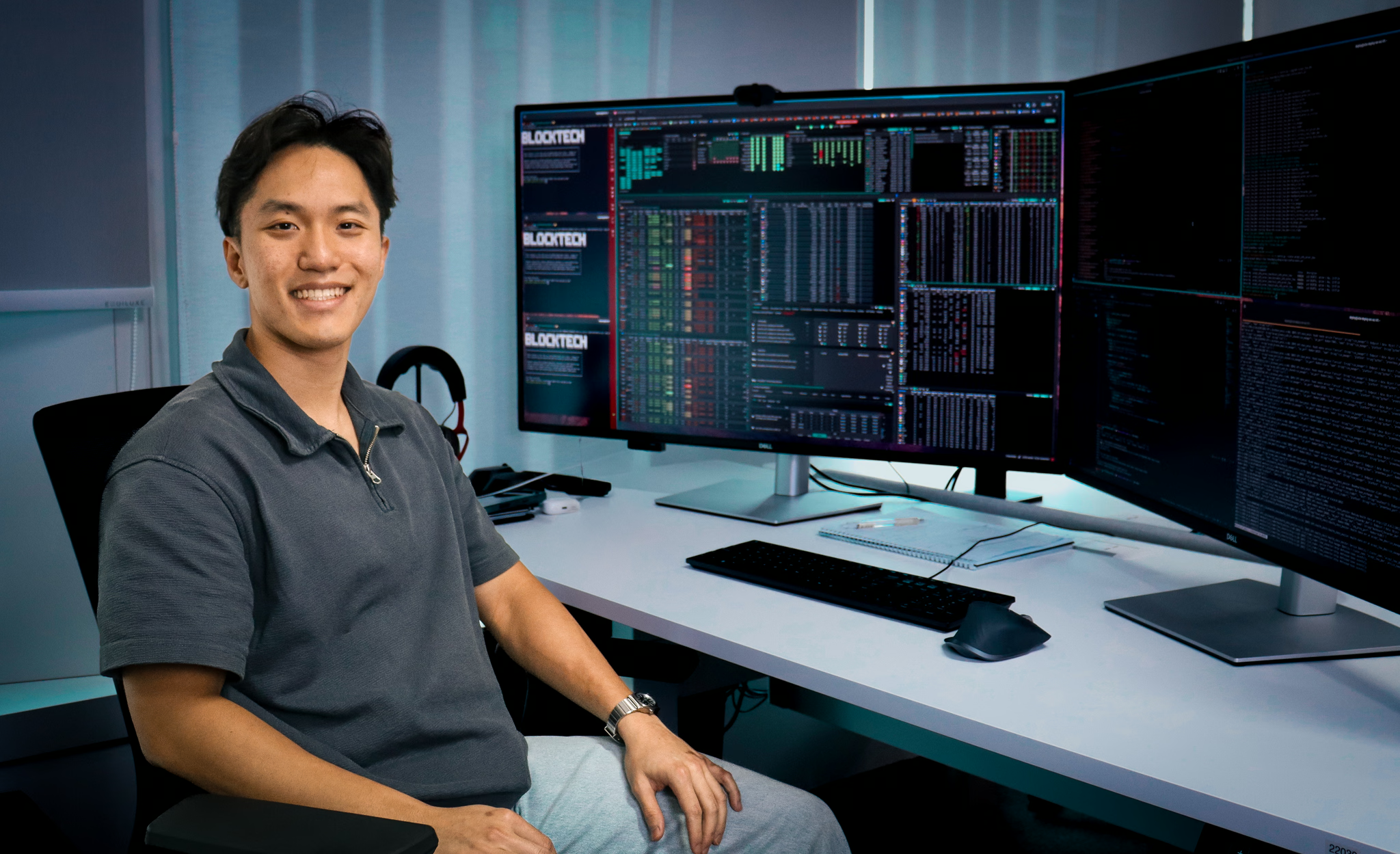
The BlockTech Advantage: How Keane Kwa Grows Fast in a Multidisciplinary World
When Keane Kwa joined BlockTech’s Singapore office as a Quantitative Developer, he expected to spend most of his time doing what the title suggests: working on models, refining pricing logic, and translating mathematical ideas into code that could support trading decisions. What he did not expect was how quickly that definition would dissolve.
A year into the role, his work no longer fits neatly into a single category. On any given day, Keane might find himself moving between quantitative development, software engineering, infrastructure troubleshooting, and execution logic that connects directly to live markets. In most organizations, these would be distinct career paths. At BlockTech, they are simply different parts of the same job.
That fluidity is not an exception inside the Singapore office of BlockTech – it is the default mode. “Initially I was hired as a quantitative developer, but along the way I’m having more of a software engineer kind of role,” Keane explains. “What I do right now doesn’t really fit in either category. One hour of the day I’m doing quantitative stuff, the other I’m doing software engineering. It’s a mix of everything.”
And it is precisely this overlap, rather than specialization, that has come to define his experience at BlockTech.
A smaller office with different challenges
The contrast with BlockTech’s Amsterdam office is one of scale and structure. In Amsterdam, teams now tend to be larger and more specialized, with responsibilities more clearly delineated across functions. Singapore, by contrast, operates with a smaller group working across the full stack of the Delta One business.
That difference in size has a direct impact on how work is distributed. Instead of narrowly defined roles, responsibilities in Singapore naturally stretch across disciplines, with individuals stepping into multiple domains depending on what the system requires at any given moment. “Because there are fewer people in Singapore, the scope of each role is broader,” Keane explains. “Each person in Amsterdam might focus on something very specific, like pricing. Here, we combine different disciplines.”
The result is a working environment where adaptability is not just useful, but necessary. Problems rarely arrive in isolated form. A latency spike, a pricing anomaly, or a change in market behavior often triggers questions that cut across software, infrastructure, and trading logic all at once. In practice, that means people are constantly shifting perspective, moving between levels of abstraction that would typically sit in different departments elsewhere.
A closer look at Delta One
Much of that complexity becomes visible in the work the Singapore office does on BlockTech’s Delta One business. While BlockTech is often associated with options trading, Delta One operates in a different part of the market structure, focusing on instruments such as futures and perpetuals that closely track the price of the underlying asset.
Keane is careful not to oversimplify it, but the distinction is important for understanding the nature of his work. Where options trading involves complex non-linear pricing and judgment-based decision-making, Delta One is closer to a continuous, more predictable system in terms of pricing. Both forms of trading require extreme precision, speed and reliability, but Delta One differs in the breadth of instruments and number of markets it covers. That wider range is a key reason why automation becomes even more critical. “It’s wrong to just say we trade Bitcoin itself,” he says. “We trade instruments with a delta of one or close to one. Futures and perpetuals fall into that category as well.”
“If you’re someone who likes solving problems from different angles — software, hardware, networking, finance and mathematics all together — then this is the place to be.”
What that means in practice is that the focus is not on predicting direction, but on building systems capable of operating efficiently in highly competitive, low-margin environments. The goal is to build highly reliable, low-latency systems that can operate seamlessly across a large number of markets. “We’re not really trying to predict what the market is going to do,” Keane explains. “It’s more about building systems that perform consistently, no matter what the market is doing.”
That kind of framing shifts the nature of the work entirely. It becomes less about isolated trading decisions and more about the engineering of an entire system that spans pricing, execution, infrastructure, and real-time data flow across multiple geographies.
A system that forces you to think in layers
For Keane, the most compelling part of the work is not any single component, but the way all components interact simultaneously. A pricing model is only as good as the data it receives. Execution logic depends on network performance. Infrastructure decisions can influence trading outcomes in subtle but meaningful ways. Everything is connected, and nothing operates in isolation. “It’s like a real-life puzzle in a real-life game,” he says.
And that puzzle never sits still. Market conditions evolve, and the systems are constantly refined. Even knowledge from outside finance often becomes relevant in unexpected ways, whether it comes from computer science, mathematics, or seemingly unrelated technical concepts encountered years earlier. “You realize that something you learned back in school and totally forgot about can suddenly become relevant again,” Keane explains. “Once you understand every small detail, everything starts to piece together. Then you can move between different perspectives and solve things from a much deeper place.”

This constant switching of context is one of the defining characteristics of his role. It is also, according to Keane, the source of its steepest learning curve. These are some of the aspects of the work he needs to take into account on a daily basis: “From the lowest level of computing, we work with cache lines, memory, threads, and the kernel, ensuring performance and scalability from a computer architecture and operating systems perspective. On top of that, we design algorithms that are performant and robust, while also making deliberate choices around hardware so the software runs efficiently both on individual machines and across networks.”
He continues: “These technical layers are always considered alongside the financial context, such as order book dynamics, interest rates, and other market mechanics. On the networking side, we look across the full OSI model and, at a broader level, focus on bandwidth, uptime, latency, and concurrency across distributed systems. Every problem therefore has both vertical and horizontal layers: depth across the stack and breadth across systems. Solving them requires understanding each piece in detail – or working closely with those who do.”
The BlockTech culture in a smaller system
The same fluidity that defines the work also shapes the culture inside the Singapore office of BlockTech. With fewer people and tighter integration between teams, collaboration happens almost by default. Knowledge moves quickly, problems are shared openly, and responsibilities are often absorbed by whoever is best positioned to act.
Keane describes it as both collaborative and unusually cohesive: “Everyone works together with everyone because everyone overlaps with each other,” he says. “And because the team is small, when we do something, everyone is aware of it. It makes it very easy to get things done and to cover for each other if necessary.”
That environment also extends beyond technical work. Regular dinners, team events, and informal gatherings help maintain a strong sense of connection across the office. There are cultural differences compared to Amsterdam, particularly in tone and social rhythm, but Keane sees that contrast as part of what makes the broader organization so interesting.
From waiting for ideas to digging for them
What stands out most in Keane’s reflection is not a single technical achievement or project milestone, but the way his understanding of his own role has evolved over time. What began as a clearly defined position has gradually expanded into something more ambiguous, and in many ways more demanding.
Early in his career, Keane noticed that solutions would sometimes come only after long periods of sustained thinking, often outside of work. Over time, that changed. As his understanding of systems deepened, the process became less about sudden insight and more about structured exploration.
“You don’t really wait for ideas to come to you anymore,” he says. “You dig into the problem, and eventually you find it.”
It is a mindset that aligns closely with the demands of the Singapore office itself: detail-oriented, cross-disciplinary, and grounded in the belief that understanding emerges through depth rather than abstraction.
Advice for those joining Singapore
For anyone considering joining BlockTech’s Singapore office, Keane is direct about what matters most. Technical skill is important, but not sufficient on its own. What matters more is curiosity across domains and a willingness to move between them without friction. “If you are someone like me, who likes to learn about different things, solving problems from different angles, from both the software and hardware side, networking, finance, math, all of those together – then this is the place to be.”
The work, he suggests, is not about becoming the best at one thing. It is about becoming effective across many different things. And that is where the real advantage lies. Not in specialization, but in the ability to wear multiple hats and switch between them without hesitation. Or, as Keane’s experience quietly demonstrates, in learning how to think like an engineer, a quantitative developer, and a systems builder all at once.
Join our newsletter
to stay up to date!
Ready to join
BlockTech?
Interested in joining Keane and the rest of the team at BlockTech? Check out our open positions.

Insights from
our team.
At BlockTech, you’ll work alongside some of the brightest minds in trading and tech, in an environment that actively supports your personal development. But don’t just take our word for it – here’s what our people have to say.




.avif)
.avif)






-303.avif)